
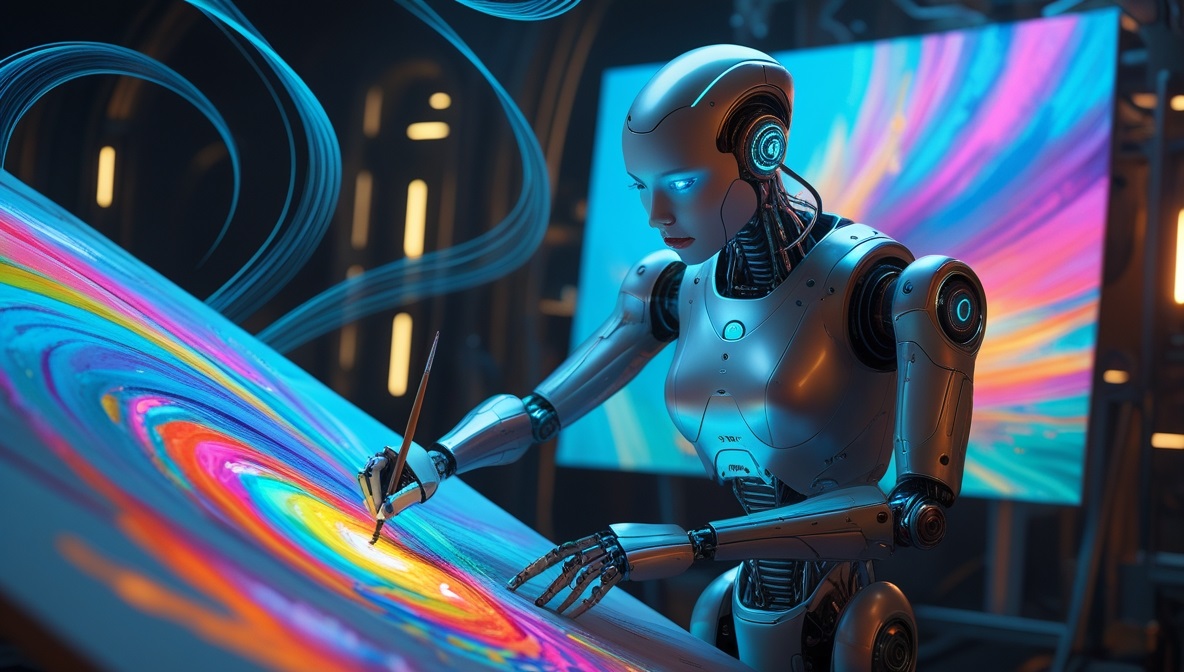
In a world where artificial intelligence (AI) is transforming industries, reshaping economies, and influencing daily life, one lingering question continues to spark debate: Can AI truly be creative? While machines have shown remarkable capabilities in replicating human behavior, creativity has long been considered a uniquely human trait – rooted in emotion, intuition, and imagination.
So, how far can AI go when it comes to creativity? Is it mimicking creativity or actually producing original, meaningful content? In this blog post, we explore the fascinating intersection of AI and creativity, the technologies behind machine imagination, and what the future might hold.
What Is Creativity, Really?
Before diving into AI’s creative capabilities, it’s essential to define what creativity means. At its core, creativity involves generating new, original ideas or artifacts that are both novel and valuable. It’s not just about producing something different – it must also have meaning or purpose.
Human creativity is influenced by culture, personal experience, emotions, and often a subconscious connection to abstract ideas. It’s a process that’s messy, non-linear, and deeply human.
How AI “Creates” Today
With advancements in machine learning, natural language processing, and generative models like GPT-4, DALL·E, and Stable Diffusion, AI has proven its ability to generate:
Text: Stories, poems, scripts, and even code.
Visual Art: Digital paintings, logos, illustrations.
Music: Compositions in the style of Bach or The Beatles.
Videos: AI-generated animations and deepfakes.
But is this real creativity – or just high-level imitation?
AI Creativity: Imitation or Innovation?
Most AI systems operate by analyzing vast datasets, identifying patterns, and producing new content based on those patterns. For example, when an AI writes a poem, it draws on thousands (or millions) of poems it has been trained on to generate something that resembles human poetry.
In this sense, AI doesn’t “feel” inspiration—it doesn’t have emotions, nor does it understand meaning like we do. Instead, it operates within predefined algorithms, optimizing for probability and coherence.
Yet, some argue that even human creativity is a remix of existing ideas. So if humans build upon prior knowledge, is AI really that different?
Key Technologies Powering AI Creativity
Generative Adversarial Networks (GANs)
GANs pit two neural networks against each other to generate highly realistic images, art, and designs.Transformer Models (like GPT)
Transformers are the backbone of advanced language models, enabling AI to understand context, syntax, and semantic relationships in language generation.Reinforcement Learning
Helps AI refine its outputs over time, improving how it “imagines” solutions or artistic expressions.
Real-World Examples of AI Creativity
OpenAI’s DALL·E: Creates detailed and surreal images from text prompts—like “a futuristic city made of cheese.”
AIVA: An AI music composer used in film scoring and game development.
ChatGPT: Helps writers brainstorm, generate dialogue, or even mimic famous authors.
These tools are used by marketers, designers, musicians, filmmakers, and writers to push the boundaries of what’s possible.
The Human-AI Collaboration Model
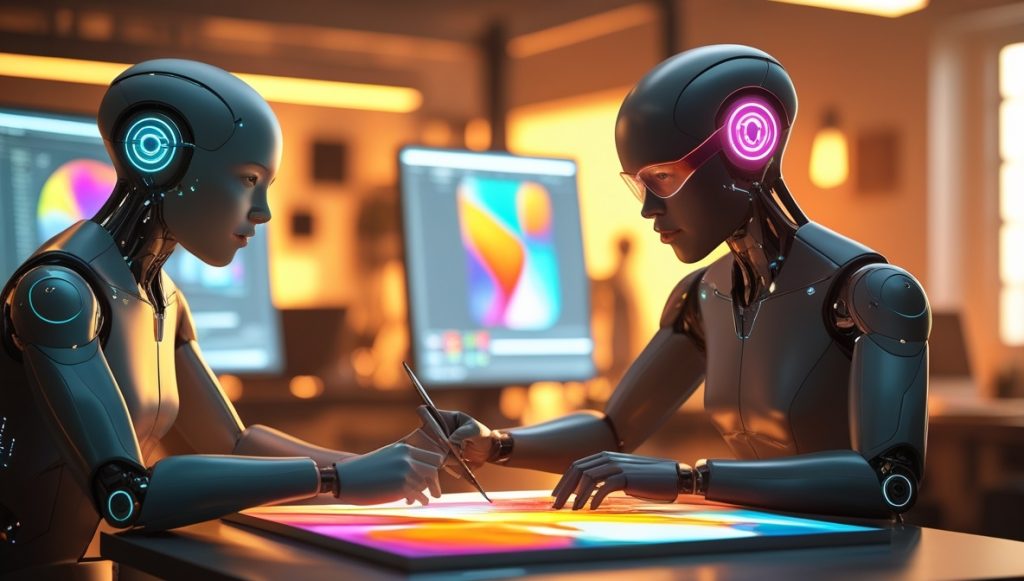
Instead of replacing human creativity, AI is increasingly seen as a co-creator – a tool that enhances and augments our creative process. For example:
Writers use AI to overcome writer’s block.
Designers explore multiple visual iterations in seconds.
Musicians experiment with new sounds and rhythms.
This collaborative model is transforming industries—from advertising and entertainment to fashion and architecture.
The Limitations of AI Creativity
Despite its advancements, AI still has significant limitations:
Lack of Consciousness: AI doesn’t “understand” what it creates.
No Emotional Insight: It can mimic emotions but cannot feel them.
Context Blindness: AI can generate out-of-place or culturally insensitive content without human oversight.
Dependence on Data: AI is only as creative as the data it’s trained on.
These boundaries remind us that while AI can assist in creative processes, it still requires human intuition, ethics, and oversight.
Will AI Ever Be Truly Creative?
This remains one of the most profound questions in AI ethics and philosophy. Some researchers believe that with enough complexity and self-awareness, machines might eventually evolve to a form of creativity that rivals human imagination. Others argue that without consciousness, desire, or subjective experience, AI will always fall short of true creativity.
For now, AI is a powerful tool – a creative partner that helps us think bigger, faster, and more boldly.
Final Thoughts
AI is pushing the boundaries of creativity, offering tools that amplify human imagination and redefine what it means to create. But true creativity – driven by emotion, experience, and personal vision – remains deeply human. By embracing AI as a collaborator rather than a competitor, we open the door to a future where machine imagination enhances, not replaces, the creative spirit.